 |
Stroke Weekly News: 726 headlines |
|
|||||||||||||

 A pregnant mother..a baby..faith of a husband.. .plus... Cardiac Standstill: cooling the patient to 15 degrees Centigrade!
| Executive Editor..Anne Merete Robbs CEO..............Stan Swartz |
||||
 |
||||
|
||||
| 4 TALES OF NEUROSURGERY & A PIANO CONCERT BY DR. SPETZLER... Plus 2 books written by Survivors for Survivors! |
||||
 |
||||
| Robert F. Spetzler M.D. Director, Barrow Neurological Institute J.N. Harber Chairman of Neurological Surgery Professor Section of Neurosurgery University of Arizona |
||||
| TALES OF NEUROSURGERY: | ||||
A pregnant mother..a baby..faith of a husband.. .plus... Cardiac Standstill: cooling the patient to 15 degrees Centigrade! |
||||
| Lou Grubb Anurism |
||||
| The young Heros - kids who are confronted with significant medical problems! |
||||
| 2 Patients...confronted with enormous decisions before their surgery...wrote these books to help others! |
||||
| A 1 MINUTE PIANO CONCERT BY DR. SPETZLER |
||||
| Sources used by our Heart & Stroke News Research Team: | ||||
| The New York Times, CNN, FOX, CBS, BBC, Mayo Clinic, Johns Hopkins Medicine, UCLA Medical Center, National Institute of Health, Stanford Hospital, Memorial Sloan- Kettering, Yale Cancer Center, Massachusetts General Hospital, Brigham and Women's Hospital, University of Michigan, M. D. Anderson Cancer Center, National Institute of Health, American Cancer Association, NBC, Reuters News, American College of Cardiology, Journal of the American Medical Association & 100's more | ||||
| Links | ||||
|
||||
| Archives | ||||
| January 2005 | ||||
| February 2005 | ||||
| March 2005 | ||||
| April 2005 | ||||
| May 2005 | ||||
| June 2005 | ||||
| July 2005 | ||||
| August 2005 | ||||
| September 2005 | ||||
| October 2005 | ||||
| November 2005 | ||||
| December 2005 | ||||
| January 2006 | ||||
| February 2006 | ||||
| March 2006 | ||||
| April 2006 | ||||
| May 2006 | ||||
| June 2006 | ||||
| July 2006 | ||||
| August 2006 | ||||
| September 2006 | ||||
| October 2006 | ||||
| November 2006 | ||||
| December 2006 | ||||
| January 2007 | ||||
| February 2007 | ||||
| March 2007 | ||||
| June 2007 | ||||
| April 2008 | ||||
| May 2008 | ||||
| January 2009 | ||||
| January 2014 |


Monday
"Viper venom could yield blockbuster stroke drug"
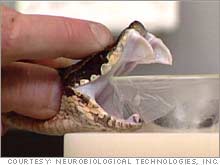
CNNCNN...READ MORE: "The next big stroke drug could come from the venomous mouth of a viper.Neurobiological Technologies, a California-based biotech, is milking the fangs of Malayan pit vipers at its Kentucky snake farm. Extracting snake venom by hand is not for the squeamish, but it could yield a drug that prevents brain damage in stroke victims......MORE"

Thursday
Lifetime Stroke Risk Drops
READ MORE: "A new study shows that your chance of having a stroke in your lifetime has dropped significantly over the past 50 years. And at least for men, the chance of dying from the disease has declined as well.
Researchers who presented the data here at the American Stroke Association's International Stroke Conference 2006 credited the trends to better control of blood pressure, cholesterol levels, and other stroke risk factors."
Researchers who presented the data here at the American Stroke Association's International Stroke Conference 2006 credited the trends to better control of blood pressure, cholesterol levels, and other stroke risk factors."
Tuesday
Heart Attack, Osteoporosis Linked in Men Over 50...Tulane University
Tulane University - READ MORE: "Men who have survived a heart attack are at increased risk of bone loss and osteoporosis in later life, says Tulane University researcher Jeanette H. Magnus.
'We have long known that heart disease and osteoporosis have similar risk factors, but this is the first study to examine the relationship between heart attack survivors and low bone mineral density,' says Magnus. Cigarette smoking, a sedentary lifestyle and poor nutrition are risk factors common to both chronic conditions. 'According to our data, people who reported a previous heart attack were more likely to have low bone mineral density than those who did not report a heart attack, but when examining this association separately for men and women it was only significant for men.'"
'We have long known that heart disease and osteoporosis have similar risk factors, but this is the first study to examine the relationship between heart attack survivors and low bone mineral density,' says Magnus. Cigarette smoking, a sedentary lifestyle and poor nutrition are risk factors common to both chronic conditions. 'According to our data, people who reported a previous heart attack were more likely to have low bone mineral density than those who did not report a heart attack, but when examining this association separately for men and women it was only significant for men.'"
Monday
ASA: Imaging 'Mismatch' Spots Stroke Patients at Need for Lysis
Primary source: American Stroke Association 2006 International Stroke Conference READ MORE: " The ischemic stroke patients at greatest need for thrombolytic therapy to save injured brain tissue may soon be triaged by a sophisticated imaging approach called mismatch, investigators said here.
Mismatch is a term used to find whether areas of the stroke-injured brain are still salvageable, as determined by two different kinds of MRI scans. One, called perfusion-weighted MRI, measures blood flow. The other, called diffusion weighted MRI, is a marker of cell injury."
Mismatch is a term used to find whether areas of the stroke-injured brain are still salvageable, as determined by two different kinds of MRI scans. One, called perfusion-weighted MRI, measures blood flow. The other, called diffusion weighted MRI, is a marker of cell injury."
Treatment for stroke shows promise - baltimoresun.com
READ MORE - baltimoresun.com
: "It sounds cruel: binding a stroke victim's good arm to force use of the weak one. But those who tried it for two weeks were better off in the long run, greatly improving their ability to do everyday tasks, such as answering the phone, doctors reported yesterday.
Stroke costs outpace payments
United Press International - READ MORE: "Medicare payments to hospitals for stroke care are lagging far behind the costs, which may imperil the care of stroke victims in the future, researchers report."
Sunday
Cost of Stroke for Hispanic-Americans Will Soar
Study estimates $334 billion in related expenditures by 2050
READ MORE: "Costs associated with ischemic stroke in Hispanic Americans are expected to top $334 billion between now and 2050, researchers warn.
Those costs include hospitalization, ongoing care and lost wages. In 2005, it's estimated that it will cost $3.1 billion to treat ischemic stroke in Hispanics. Ischemic stroke is caused by a blockage in an artery that supplies blood to the brain.
The findings were presented Friday at the American Stroke Association's International Stroke Conference in Kissimmee, Fla.
For their cost projection, researchers used Medicare and U.S. census data, along with information about stroke occurrence and the use of health-care resources after stroke.
Hispanics recently became the largest minority group in the United States and will make up an estimated 25 percent of the population by 2050.
Hispanics are twice as likely to develop ischemic stroke as non-Hispanic whites, the study noted.
'Three risk factors for stroke -- inactivity, obesity and diabetes -- tend to be more common in the Hispanic population,' study lead author Dr. Devin L. Brown, assistant professor of neurology at the University of Michigan, said in a prepared statement.
"
VISIT OUR MD HEALTH CHANNEL "En Espanol"
SCROLL DOWN
READ MORE: "Costs associated with ischemic stroke in Hispanic Americans are expected to top $334 billion between now and 2050, researchers warn.
Those costs include hospitalization, ongoing care and lost wages. In 2005, it's estimated that it will cost $3.1 billion to treat ischemic stroke in Hispanics. Ischemic stroke is caused by a blockage in an artery that supplies blood to the brain.
The findings were presented Friday at the American Stroke Association's International Stroke Conference in Kissimmee, Fla.
For their cost projection, researchers used Medicare and U.S. census data, along with information about stroke occurrence and the use of health-care resources after stroke.
Hispanics recently became the largest minority group in the United States and will make up an estimated 25 percent of the population by 2050.
Hispanics are twice as likely to develop ischemic stroke as non-Hispanic whites, the study noted.
'Three risk factors for stroke -- inactivity, obesity and diabetes -- tend to be more common in the Hispanic population,' study lead author Dr. Devin L. Brown, assistant professor of neurology at the University of Michigan, said in a prepared statement.
"
VISIT OUR MD HEALTH CHANNEL "En Espanol"
SCROLL DOWN
Estudio calcula $344 mil millones en gastos relacionados para 2050
EN ESPANOL: "El costo de los accidentes cerebrovasculares de los estadounidenses de origen hispano se disparar�"
Saturday
WATCH VIDEO: Skinny kids and heart disease
CLICK HERE TO READ MORE...plus WATCH VIDEO: "Coronary heart disease (CHD) is sometimes called coronary artery disease. A coronary artery is a blood vessel that carries blood to your heart. Your arteries are like narrow tubes. A fatty substance called plaque can build up in your arteries, blocking or slowing the flow of blood and oxygen through them. This can happen in any artery, but when it happens in the coronary arteries, your heart doesn't get the blood and oxygen it needs to work properly.
Coronary heart disease can lead to serious health problems, including angina (pain or pressure in the chest) and heart attack. About 12.6 million Americans suffer from CHD, which often results in a heart attack. About 1.1 million Americans suffer a heart attack each year -- about 515,000 of these heart attacks are fatal....MORE"
Coronary heart disease can lead to serious health problems, including angina (pain or pressure in the chest) and heart attack. About 12.6 million Americans suffer from CHD, which often results in a heart attack. About 1.1 million Americans suffer a heart attack each year -- about 515,000 of these heart attacks are fatal....MORE"
Clot-Busting Drug Helps Stroke Recovery
read more: "Like pouring Drano directly on a clog, doctors dramatically improved stroke survival by dripping a clot-dissolving drug right onto a blockage choking off the brain's blood supply. Many patients given this experimental treatment had stunning recoveries within a day, often without the speech loss and paralysis that can follow a stroke, doctors reported Thursday. "
Friday
Most Stroke Patients Miss Out on Clot-Busting Drug...ar too many wait too long to seek care, researchers say
READ MORE: "Even though it can save lives threatened by stroke, only a very small percentage of patients are getting a powerful clot-busting drug, a new U.S. survey finds.
Of nearly 2,100 people treated for strokes caused by a blood clot at 15 hospitals in Michigan over a six-month period, just 2 percent received tissue plasminogen activator (tPA), according to a report published in Feb. 14 issue of Neurology.
The fault for the low use of tPA lies partially with hospitals, and partially with patients who wait too long to seek help for their symptoms. To work effectively, tPA must be given within three hours of the start of a stroke."
Of nearly 2,100 people treated for strokes caused by a blood clot at 15 hospitals in Michigan over a six-month period, just 2 percent received tissue plasminogen activator (tPA), according to a report published in Feb. 14 issue of Neurology.
The fault for the low use of tPA lies partially with hospitals, and partially with patients who wait too long to seek help for their symptoms. To work effectively, tPA must be given within three hours of the start of a stroke."
Saturday
FDA Warns Heart Surgery Drug Tied to Risks
MORE: " A drug used to prevent blood loss during heart bypass surgery has been linked to higher risks of serious side effects, including kidney problems, heart attacks and strokes, health officials warned doctors and patients Wednesday. The Food and Drug Administration said it was evaluating the safety of Trasylol, formally known as aprotinin, in light of two studies published in January that link its use to the problems. The drug's maker, Germany-based Bayer AG, said the drug is safe and effective when used correctly in artery bypass graft surgery patients. Bayer added in a statement that it will continue working with regulatory authorities 'in all countries where Trasylol is marketed to address questions regarding product safety.' The company previously said it had contacted officials in the United States, Canada, Australia and Europe. Trasylol is the only FDA-approved drug to stanch the loss of blood and prevent the need for blood transfusions in surgeries to bypass clogged coronary arteries. The FDA recommended that doctors monitor patients for toxicity, particularly to the kidneys, heart or central nervous system, following use of the drug. They also should consider limiting the drug's use to cases in which the need to reducing blood loss outweighs any risks......."
Thursday
Cocoa May Help Reduce Heart Disease, Cancer, Mars Study Shows
READ MORE: "Cocoa may help reduce the risk of
heart disease and cancer, a 10-year study by candy producer Mars
Inc. and Harvard University showed.
The study, to be released in Washington today, is the first
to connect cocoa to the prevention of cancer in humans, Harold
Schmitz, chief science officer of Mars and co-author of the
study, said in an interview yesterday. Mars six months ago began
selling ``heart-healthy'' CocoaVia chocolate bars in Wal-Mart
Stores Inc. and other retailers.
Flavanols contained in cocoa, as well as apples, almonds
and grapes, may provide the protection, Schmitz said. ``It looks
like there is a tremendous benefit to consuming flavanol-rich
cocoa, a greater benefit than any of us could have
anticipated.''
The study looked at death certificates of about 1,250 Kuna
Indians in Panama and in the San Blas islands off the coast of
Panama. The Kunas in the San Blas Islands drank four or five
cups of a cocoa-water drink a day, while the Kunas in Panama did
not."
heart disease and cancer, a 10-year study by candy producer Mars
Inc. and Harvard University showed.
The study, to be released in Washington today, is the first
to connect cocoa to the prevention of cancer in humans, Harold
Schmitz, chief science officer of Mars and co-author of the
study, said in an interview yesterday. Mars six months ago began
selling ``heart-healthy'' CocoaVia chocolate bars in Wal-Mart
Stores Inc. and other retailers.
Flavanols contained in cocoa, as well as apples, almonds
and grapes, may provide the protection, Schmitz said. ``It looks
like there is a tremendous benefit to consuming flavanol-rich
cocoa, a greater benefit than any of us could have
anticipated.''
The study looked at death certificates of about 1,250 Kuna
Indians in Panama and in the San Blas islands off the coast of
Panama. The Kunas in the San Blas Islands drank four or five
cups of a cocoa-water drink a day, while the Kunas in Panama did
not."
Wednesday
CBS News | McDonald's Fries Got Even Fattier
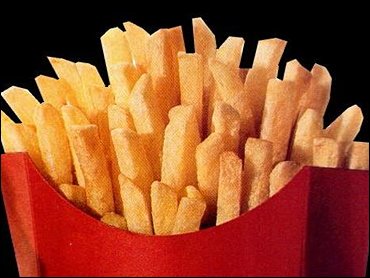
CBS News READ MORE: "McDonald's french fries just got fatter %u2014 by nutritional measurement. The world's largest restaurant chain said Wednesday its fries contain a third more trans fats than it previously knew, citing results of a new testing method it began using in December. That means the level of potentially artery-clogging trans fat in a portion of large fries is eight grams, up from six, with total fat increasing to 30 grams from 25...."
Tuesday
Reducing fat didn't reduce cancer, heart risks
READ MORE: "An eight-year study that monitored nearly 50,000 women produced some startling results, finding that a low-fat diet made virtually no difference in their chances of developing a number of health problems, including breast cancer.
The massive, $415-million US study is set to be published on Wednesday in the Journal of the American Medical Association, and was conducted as part of the Women's Health Initiative, a U.S. government project.
Study participants who followed a high veggie, low-fat diet were just as likely to develop heart disease, stroke, colon cancer or breast cancer as those who were much less disciplined in their eating habits."
The massive, $415-million US study is set to be published on Wednesday in the Journal of the American Medical Association, and was conducted as part of the Women's Health Initiative, a U.S. government project.
Study participants who followed a high veggie, low-fat diet were just as likely to develop heart disease, stroke, colon cancer or breast cancer as those who were much less disciplined in their eating habits."
Monday
Helping Damaged Heart Cells to Heal
CLICK HERE TO READ MORE: "The role of a major naturally-occurring protein which can promote healing after heart attacks has been discovered by researchers at Toronto General Hospital, University Health Network."
Diet is important when taking blood thinners
CLICK HERE TO READ MORE: "...Warfarin thins the blood by limiting the ability of the liver to produce clotting factors.
Most individuals do not have to change their diets because they begin taking warfarin, but they do need to be cautious that they don't make certain dietary changes after beginning to take this medication."
Most individuals do not have to change their diets because they begin taking warfarin, but they do need to be cautious that they don't make certain dietary changes after beginning to take this medication."
Penn Study Identifies Patients Most At-risk For Secondary Strokes
CLICK HERE TO READ MORE: "Among patients who have suffered a single stroke, researchers at the University of Pennsylvania School of Medicine, along with colleagues at other institutions, have found that severe stenosis, or narrowing, of the arteries in the head represents a major risk factor for the development of a subsequent stroke. Patients with recent symptoms were also at high risk."
Strokes can happen to anyone at any age
CLICK HERE TO READ MORE: "First and second second periods went by fine for Vandna Mittal but during third-period English, the sophomore developed a severe left-side headache.
‘‘Vandna was sitting behind me. Her eyes were bloodshot, and she couldn't understand what we were reading in class,' said longtime friend Megan Parke.
Megan knew academic Vandna, then 15, wasn't acting like herself; luckily class was almost over.
‘‘I thought it was a migraine or something,' Megan said.
When Vandna got to math class around 10:40 a.m., after the nine-minute passing period, she felt numbness on her left side and sat down briefly."
‘‘Vandna was sitting behind me. Her eyes were bloodshot, and she couldn't understand what we were reading in class,' said longtime friend Megan Parke.
Megan knew academic Vandna, then 15, wasn't acting like herself; luckily class was almost over.
‘‘I thought it was a migraine or something,' Megan said.
When Vandna got to math class around 10:40 a.m., after the nine-minute passing period, she felt numbness on her left side and sat down briefly."
Reuters: Poor kidney function ups death risk in heart failure
CLICK HERE TO READ MORE: "Impaired kidney function raises the risk of death and hospital admission in patients with chronic heart failure, even among those patients with fairly well preserved heart-pumping action, study findings suggest."
Thursday
Popular Drugs May Fight Arthritis & Breast Cancer
CLICK HERE TO READ MORE: "There's more evidence that the same controversial prescription pain relievers, suspected of raising heart attack risk, may actually help prevent certain cancers."
Reuters: US women still neglect heart risk, studies find
CLICK HERE TO READ MORE: "U.S. women still do not fully understand their high risk of heart disease and are confused by reports that suggest being overweight and inactive are not really that dangerous, the American Heart Association said on Tuesday."
Reuters: Depression raises risk of cardiac arrest
CLICK HERE TO READ MORE: "Even in patients without risk factors for heart disease, depression seems to increase the odds of suffering cardiac arrest, in which the heart suddenly stops beating properly, new research suggests."